By Jonathan Oh, CEO – SupplyCart / ADAM-Procure
At CPO2025 in Kuala Lumpur, one of the panellists joked, “If you ask most people in the business what procurement does, they’ll say: ‘slow things down and ask for three quotes.’”
Everyone laughed because it still feels uncomfortably true.
In many Malaysian organisations, procurement is still seen as a cost-control function and policy gatekeeper. But the conversations at CPO2025 and the FMM Supply Chain Webinar painted a very different picture of where the function is headed. CPOs are now being asked to deliver resilience, ESG outcomes, supplier innovation, and talent development—while still keeping a firm grip on savings.
Procurement is shifting from cost centre to value engine. The question is no longer if this shift will reach you, but how quickly you can respond.
This article looks at what Malaysian leaders are actually doing to make that shift, and how having the right digital backbone—platforms like ADAM-Procure—turns good intentions into everyday practice.
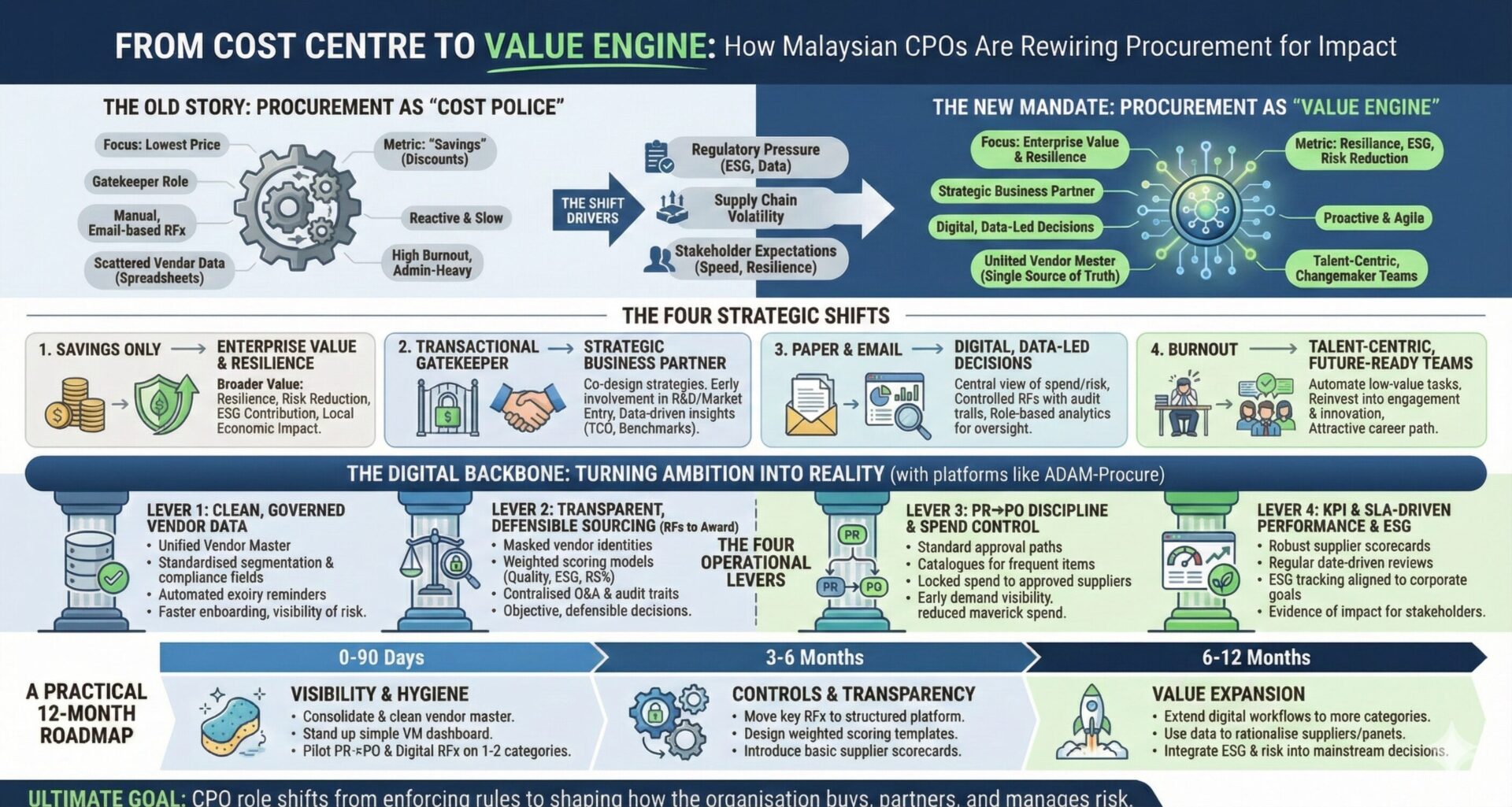
The old story: procurement as “cost police”
For years, the narrative around procurement has been relatively narrow: get the lowest price, enforce the rules, and keep enough of an audit trail to satisfy finance and compliance. You can recognise organisations stuck in this story quite easily. Vendor data lives in multiple spreadsheets and inboxes. Savings are reported as negotiated discounts with little link to real business outcomes. RFx processes are run via email, with criteria that shift as the event goes along. Teams spend more time chasing signatures and documents than talking to stakeholders or suppliers.
It’s not hard to see why this model is no longer enough. Regulatory expectations around ESG, anti-bribery and data protection are rising. Supply chains have become more volatile and exposed to geopolitical and logistics shocks. Internal stakeholders expect faster launches, better service, and more resilient partners.
You can’t spreadsheet your way to the kind of agility, visibility and accountability Malaysian CPOs are now being held to. The old model simply doesn’t have the structural strength.
The new mandate: enterprise value, not just savings
Across both CPO2025 and the FMM webinar, the same message came through repeatedly: high-performing procurement teams are reframing their remit around enterprise value, not just cost.
First, they are broadening how they define “value”. Savings still matter, but they sit alongside resilience, risk reduction and ESG contribution. One large Malaysian financial institution, for example, has pushed responsible sourcing far enough that virtually all active suppliers are now ESG-screened and moving onto shared ESG materials. At the same time, they have deliberately invested in local suppliers to uplift the domestic economy. Procurement is being used as a lever to build long-term, sustainable value, not just shave a few percentage points off spend.
Second, procurement is moving from transactional gatekeeper to strategic business partner. Leaders from tech, construction, manufacturing and financial services all emphasised the same point: procurement has to speak the language of the business. That means helping shape category strategies with operations, marketing, IT and product teams; joining discussions on new products and markets early rather than just running a tender at the end; and bringing real insight to the table in the form of supplier benchmarks, risk scenarios and total cost views. None of that is realistic if the team is submerged in manual reconciliation and chasing three quotes.
Third, the function is becoming more data-led. Digitalisation is no longer about putting an “e-” in front of procurement. It is about building a reliable evidence base. Teams that are further along have a central view of suppliers, spend and risk; controlled RFx processes with proper audit trails; and role-based dashboards showing cycle times, on- vs off-contract spend, supplier performance and ESG coverage. Without this, policies remain aspirational. With it, procurement leaders can sit down with the CFO, COO or Board and talk impact, not anecdotes.
Finally, there is a clear focus on people. The CPOs who described procurement as a “changemaker” function talked about burnout and talent just as much as systems. They want teams that spend less time on low-value, manual work and more time on stakeholder engagement, supplier development and innovation. AI and automation were hot topics—but always with the reminder that if data and processes are not in order, AI simply automates chaos. This is where a solid platform like ADAM-Procure makes the difference between hype and value.
The four levers Malaysian CPOs are pulling
So what does this transformation look like in practice? Across client work and the case studies discussed at CPO2025 and FMM, four concrete levers keep appearing.
Lever 1 – Clean, governed vendor data
Everything begins with vendor management. The teams making the most progress are consolidating vendor information into a single, governed source of truth. Instead of multiple versions of the same supplier in different systems, they maintain a unified vendor master with deduplicated records. Suppliers are tagged by category and criticality; their licences, certifications, insurance, ESG attributes and risk indicators are captured in a standard way. Expiry dates trigger reminders instead of surprises.
The benefits show up quickly. Onboarding and qualification of new suppliers becomes faster and less error-prone. Finance sees fewer “ghost vendors” and duplicates. CPOs gain a clearer view of where they are truly dependent on individual suppliers, and where risk is concentrated.
ADAM-Procure’s Vendor Management module is designed exactly for this: structured records, configurable fields for risk and ESG, recertification workflows and dashboards that give both CPOs and CFOs a shared view of the supplier landscape.
Lever 2 – Transparent, defensible sourcing from RFx to award
The second lever is pulling RFx events out of email and into a controlled environment. The aim is not to add bureaucracy, but to replace ambiguity with structure.
Teams that have made this move talk about the confidence that comes from masked vendor identities during scoring, standardised scoring models that balance commercial and non-commercial criteria, and centralised Q&A where every supplier sees the same clarifications. They know exactly who was invited, when bids were submitted, how scores were calculated and who approved the final award.
This directly addresses many of the headaches Shangrong highlighted: allegations of bias, inconsistent evaluation standards between teams, and the struggle to explain a decision to audit or management months after the event. In ADAM-Procure, RFx events are configured with criteria and weightings upfront; evaluators score inside the system; Q&A and changes are logged. You end up with a complete narrative from invitation to award instead of a patchwork of inboxes and spreadsheets.
Lever 3 – PR→PO discipline and visible spend control
The third lever involves connecting requisitions, approvals and ordering into a coherent process. When purchase requests, approvals and POs live in separate tools—or are simply buried in email—it becomes almost impossible to control off-contract spend or see budget usage in time to do anything about it.
Teams that implement structured PR→PO workflows describe a different experience. Requests follow standard paths with clear approval rules. Frequently purchased items and services are available via catalogues. Spend can be locked to approved suppliers for certain categories. Finance gains early visibility of demand instead of being surprised by invoices later.
ADAM-Procure’s Procure-to-Pay capabilities support this by bringing PR, approval and PO creation into one flow without making life unnecessarily hard for end users. The goal is not to slow the business down; it is to ensure that spend is visible, aligned with strategy, and compliant with policy.
Lever 4 – Performance and ESG built into the relationship
The fourth lever takes procurement beyond the initial contract into ongoing performance and ESG. Teams that have embraced the “value engine” role treat supplier relationships as something to be measured and developed, not just monitored occasionally.
They use simple but consistent scorecards for key suppliers, covering delivery performance, quality incidents, responsiveness and contribution to innovation. They hold regular performance reviews grounded in data rather than anecdote. They track whether suppliers are living up to ESG commitments—whether codes of conduct have been signed, certifications maintained, assessments completed.
The Maybank responsible sourcing journey is a good illustration. By automating parts of the supplier process, they managed to reduce sourcing cycle times while deepening ESG screening and support for local suppliers. That is procurement acting as a lever for compliance, trust and local economic development at the same time.
Within ADAM-Procure, these elements are brought together via performance dashboards, incident and corrective-action tracking, and configurable ESG fields that feed straight into decision-making.
Talent and story: what changes inside the function
When you put these levers together—vendor data, transparent RFx, PR→PO discipline and structured performance—the internal story of procurement changes.
Instead of arriving at executive meetings with folders of spreadsheets, CPOs can show clear, visual views of risk and resilience, not just spend. They can demonstrate how procurement supports ESG and local supplier ambitions with real numbers. They can outline a roadmap for improvement backed by data from actual operations.
That in turn makes the function more attractive to talent. People who want to think strategically, use data, and work with stakeholders are far more likely to join and stay when they see procurement playing a central role in how the organisation buys, partners and manages risk, rather than being stuck in an endless cycle of admin.
A practical 12-month path from cost centre to value engine
This shift doesn’t have to be a giant transformation programme. Most Malaysian organisations can make visible progress over a 12-month period if they focus on the right sequence.
In the first 90 days, the priority is visibility and hygiene. That usually means consolidating and cleaning the vendor master, putting a basic vendor dashboard in place, and choosing one or two categories to pilot PR→PO discipline and digital RFx. You want to move quickly from “we don’t really know what our vendor landscape looks like” to a clear baseline.
Between months three and six, the focus moves to controls and transparency. Key RFx events should begin to run through a structured platform like ADAM-Procure. Weighted scoring templates aligned to your real priorities are designed and tested. Basic supplier scorecards are introduced for your top suppliers, even if they initially focus on just one or two metrics such as on-time delivery and quality.
From month six to twelve, you start expanding value. PR→PO and RFx standards can be extended to more categories and business units. Data from the system can be used to rationalise supplier panels, negotiate performance-based agreements, and embed ESG and risk indicators into mainstream decision-making, including approval workflows and supplier segmentation.
At each stage, procurement takes on a clearer role in shaping how the organisation buys, rather than just enforcing rules at the back end.
Ready to benchmark where you are?
If you recognise your organisation in the “old story” but see where you need to go, the next step is simply understanding where you are on the curve.
We’re offering a complimentary 30-minute Vendor Management / RFx maturity check for Malaysian organisations.
In that session, we’ll:
- Review your current state across vendor data, RFx controls, PR→PO discipline, and supplier/ESG KPIs.
- Highlight 2–3 fast wins you can deliver in the next 90 days.
Show how ADAM-Procure can act as the backbone for your journey from cost centre to value engine, without ripping out your ERP.
👉 If you’d like to schedule a session, get in touch and we’ll find a time that works.
https://adam-procure.com/contact-us/
The shift is already underway. Malaysian CPOs are stepping into a bigger mandate, one built on visibility, accountability, and value creation. With the right foundations in place, procurement doesn’t just protect the bottom line; it helps grow the business.
See ADAM in action.
Get started and our friendly team will take care of the rest.
Explore how ADAM can transform your vendor management strategy today.