By Jonathan Oh, CEO – SupplyCart / ADAM-Procure
5 real use cases that actually work with your data today
Agentic AI is one of those phrases that has started appearing in board slides and vendor pitches, usually accompanied by a vague promise that “the machine will run your sourcing end-to-end.”
That’s not where the real value is today.
The practical opportunity for procurement this quarter is much simpler: let AI agents handle the repetitive, rules-based work around RFx and vendor management, while humans focus on stakeholder partnering, negotiation, and judgement. The catch—exactly as Ron from Google cautioned—is that this only works if your underlying data and governance are in decent shape. If your RFx history lives in email threads and shared drives, agentic AI will only automate the mess.
This article lays out five concrete use cases that are realistic for a team already running on a structured platform like ADAM-Procure. They all sit on top of the same spine: vendor master, RFx, approvals, masked evaluation, and audit trails.
What “agentic AI” actually means in procurement
In this context, an agent is not a chatbot that answers generic questions. It is a digital junior analyst that can follow a defined workflow:
- pull information from systems like ADAM,
- transform and structure it (e.g. from stakeholder emails to a formal RFx),
- call other tools where needed, and
- hand the result back for human review and approval.
It works inside your rules—role separation, approval limits, masking—rather than circumventing them.
Think of it as adding a tireless analyst to the team who never forgets where a document is, never gets bored collating scores, and always leaves a clean audit trail.
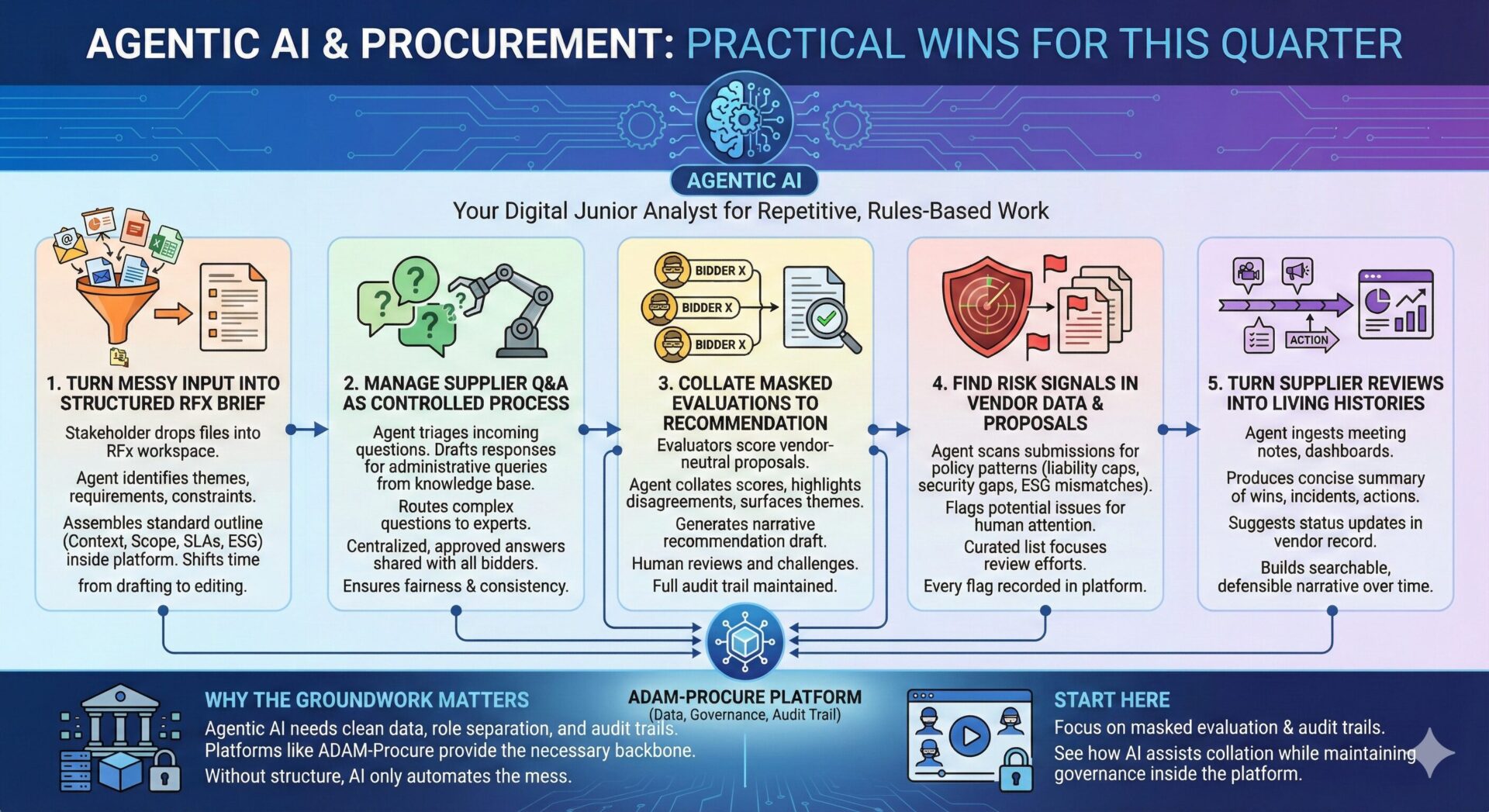
Use Case 1: Turning messy stakeholder input into a structured RFx brief
Every category manager knows the scenario: a business owner sends a mix of PowerPoint slides, a five-paragraph email, and last year’s supplier proposal with the instruction, “We need to go back to market.” Pulling that into a clear RFx brief can take half a day.
With an AI agent connected to ADAM, that workflow changes. The stakeholder drops those files into the RFx workspace. The agent reads through them, identifies recurring themes—objectives, must-have requirements, nice-to-haves, constraints like go-live dates or regulatory approvals—and assembles them into your standard RFx outline:
- business context,
- scope of work,
- service levels,
- success measures,
- ESG and risk expectations.
The first draft won’t be perfect, but instead of starting from a blank page you begin with something that already uses your headings, your language, and your governance requirements. The category manager’s time shifts from “writing from scratch” to “editing and challenging,” and the whole preparatory phase compresses from days to hours.
Because this happens inside ADAM, the templates are controlled, the criteria are aligned to your policy, and every change is logged. The agent accelerates the work; it doesn’t invent a sourcing strategy on its own.
Use Case 2: Managing supplier Q&A as a controlled, semi-automated process
On any sizable RFx, supplier questions can quickly become a burden. One team answers in Outlook, another sends a PDF with clarifications, and not every vendor receives the same information at the same time. It is exactly the kind of process that worries audit.
In a more mature setup, all questions arrive via the RFx module in ADAM. The AI agent sits on top of that stream and starts doing basic triage. It recognises recurring administrative questions (“Can we get an extension?”, “Which currency should we use?”), finds previous answers from your knowledge base, and proposes draft responses that mirror your standard position.
More complex questions—about legal clauses, technical detail, or unusual commercial structures—are tagged and routed to the right internal owner, but still come back through the same channel. Procurement reviews everything, adjusts where needed, and hits approve. Once approved, the answer is posted to a shared Q&A log, and all participating suppliers see the same clarification.
The agent provides speed and consistency; ADAM provides the transparency and role separation. When someone later asks, “Did we treat all bidders fairly?” you can point to a central log, not hunt through individual mailboxes.
Use Case 3: Collating masked evaluations into an approval-ready recommendation
This is where agentic AI becomes particularly powerful, because it sits on a foundation of masked, vendor-neutral evaluation and a full audit trail.
Imagine a high-value RFx where multiple evaluators score proposals inside ADAM. During the scoring phase, vendor names are masked; evaluators see “Bidder 1”, “Bidder 2”, and so on, along with the answers to each section and the criteria they are meant to apply.
As evaluators submit their scores and comments, ADAM locks the entries and records who did what, and when. Once all scoring is complete, procurement lifts the mask for the final stage. At this point, an AI agent steps in.
Instead of manually downloading spreadsheets and building tables, the agent:
- collates the scores by criterion and by bidder,
- highlights where evaluators significantly disagree,
- surfaces recurring themes in the written comments (“strong implementation plan”, “unclear support model”, “weak ESG evidence”), and
- assembles a narrative recommendation that reads like the first draft of a decision paper.
The category manager then challenges the result: do the conclusions make sense, are there commercial or risk nuances to add, does this align with market intelligence? What used to be two or three tedious days of collation becomes a few focused hours of review and judgement.
Crucially, nothing about governance is bypassed. ADAM still locks the scores, records exactly when identities were revealed, and stores the AI-generated summary as part of the RFx record. If internal audit later retraces the decision, every step is visible.
Use Case 4: Finding risk signals in vendor data and proposals
Supplier risk often hides in the fine print rather than the headline price. A subtle limitation of liability clause, an inconsistent answer on data security, a vague statement about labour standards—each on its own might slip past a busy reviewer.
An AI agent, especially when plugged into a platform like ADAM that already centralises vendor profiles and RFx submissions, can play the role of risk spotter. It scans proposals and responses looking for patterns your policy cares about: for example, instances where liability is heavily capped, where response times fall below your standard, or where ESG answers don’t match the commitments a vendor made at onboarding.
The agent doesn’t make the risk decision itself; it assembles a short list of points that deserve human attention. For each bidder, it might generate a paragraph along the lines of: “Flag: liability capped at 12 months of fees versus standard uncapped for data breaches; Flag: no independent certification for information security; Strength: strong track record servicing similar clients in region.”
The risk team and procurement then step in to decide what to do: ask clarifying questions, negotiate stronger terms, or reassess the overall evaluation. The difference is that they are reacting to a curated set of potential issues, not trying to read every line of every attachment under time pressure.
Again, every flag and decision can be stored as part of the RFx file in ADAM, reinforcing the audit trail and reducing the chance of “we didn’t see that” later.
Use Case 5: Turning supplier reviews into living performance histories
Quarterly reviews with strategic suppliers often generate dense PowerPoint decks, long conversations, and a list of agreed actions. Three months later, half those actions have slipped because the notes are buried in someone’s notebook or a forgotten folder.
With an AI agent, the input to that process doesn’t change: you still have performance dashboards, meeting notes, and perhaps a transcript from a virtual call. What changes is what happens afterwards.
The agent ingests the material and produces a concise summary: key wins, major incidents, root causes, and the agreed remedial actions with owners and dates. It also suggests updates to the vendor’s performance status in ADAM—whether their risk rating should be adjusted, whether specific KPIs should be highlighted, whether a follow-up review should be scheduled sooner.
Procurement and the supplier representative review this summary, confirm the action list, and save it back into the vendor record. Next quarter, you begin the review by looking at what was agreed and what was delivered. Over time, you build a narrative history of the relationship that is searchable, shareable with new team members, and defensible when challenged.
This is another example of AI doing the heavy lifting on synthesis, while the platform provides the structure and continuity.
Why the groundwork still matters
In all five examples, the agent is never asked to “run procurement.” It is asked to:
- work with structured RFx and vendor data,
- follow predefined workflows and templates,
- operate within role boundaries, and
- leave a trail of what it did.
That’s why platforms like ADAM-Procure are a necessary precursor. They supply clean data, enforce role separation, support masked evaluation, and capture every interaction in an audit trail. Without that backbone, agentic AI has nowhere safe to operate.
If your current environment is still dominated by spreadsheets, file shares, and personal inboxes, the sequence is clear: first move your vendor and RFx processes into a system; then layer agents on top. Skipping that step usually means your AI pilots stall or produce outputs that audit and risk cannot accept.
See masked evaluation + audit trails in action
If you’re deciding where to start, the most compelling place is often the evaluation stage: that’s where stakeholder frustration, time pressure, and governance concerns all meet.
A focused demonstration of masked evaluation with AI-assisted collation inside ADAM-Procure shows, in one flow, how:
- evaluators score vendor-neutral,
- scores are locked and identities revealed only when appropriate,
- an agent can build the first draft of the recommendation, and
- every action sits inside a complete audit trail.
From there, it’s straightforward to extend agents to RFx drafting, Q&A, risk spotting, and supplier reviews—one practical win at a time.
👉 See masked evaluation + audit trails in action and decide which of these agentic AI use cases your procurement team can realistically ship this quarter.
👉 If you’d like to schedule a session, get in touch and we’ll find a time that works.
https://adam-procure.com/contact-us/
The shift is already underway. Malaysian CPOs are stepping into a bigger mandate, one built on visibility, accountability, and value creation. With the right foundations in place, procurement doesn’t just protect the bottom line; it helps grow the business.
See ADAM in action.
Get started and our friendly team will take care of the rest.
Explore how ADAM can transform your vendor management strategy today.