By Jonathan Oh, CEO – SupplyCart / ADAM-Procure
Building an operating system for vendor trust
Most organisations don’t lose sleep over “one bad supplier.” They lose sleep because they can’t clearly answer three basic questions:
- Are we working with the right suppliers?
- Do we actually understand our exposure?
- If someone challenged our process tomorrow, could we prove it was fair and controlled?
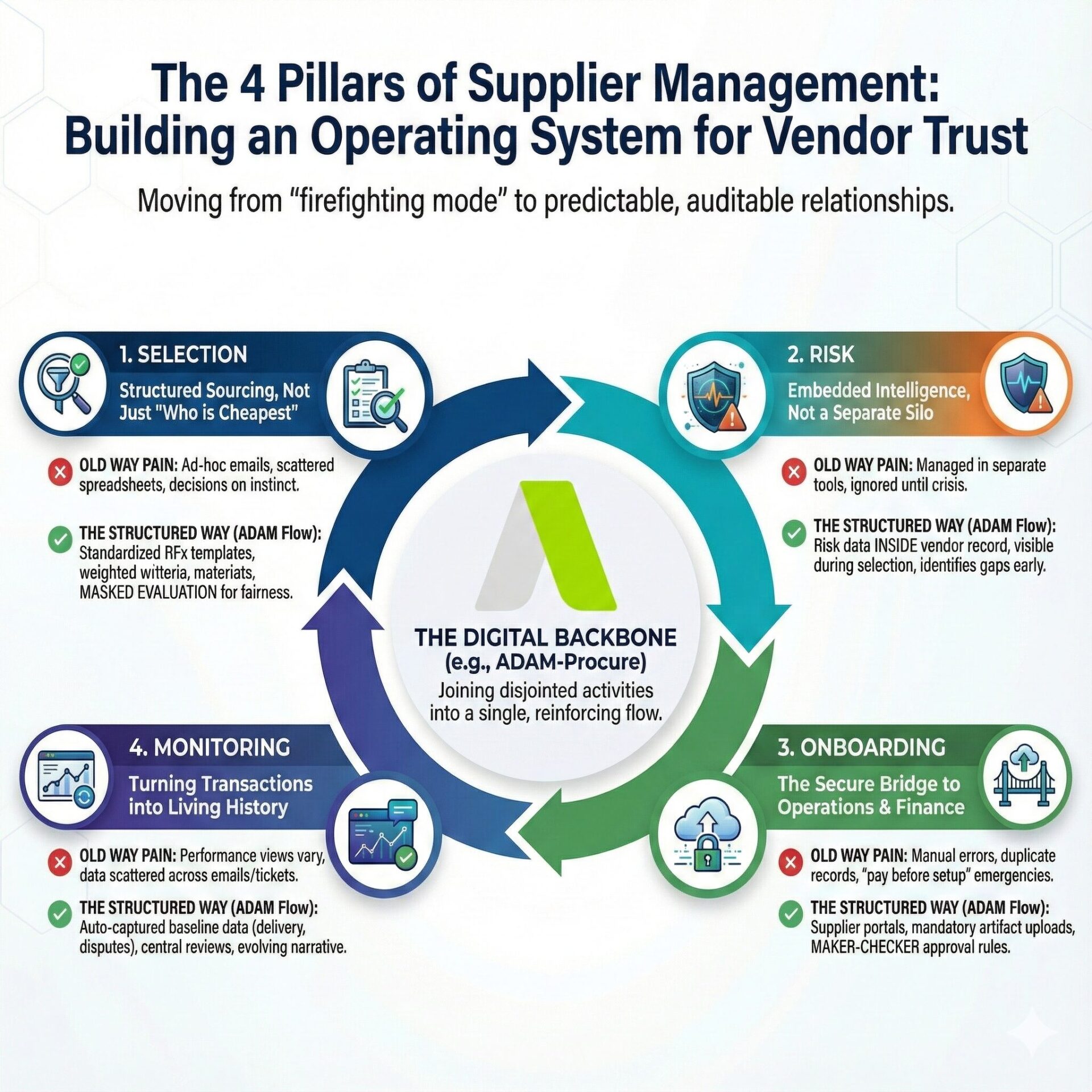
In Jon’s FMM session on supplier management and sourcing, these questions kept surfacing in different forms. Underneath the case studies and examples was a simple structure for doing supplier management properly: Selection, Risk, Onboarding, Monitoring.
Think of these as the four pillars of your operating system for vendor trust. When they’re weak, procurement lives in firefighting mode. When they’re strong, you get predictable suppliers, cleaner audits, and far fewer late-night escalations.
This article unpacks each pillar with practical examples and shows how a platform like ADAM-Procure can join everything up from registration, through RFx, all the way to PO and performance.
Pillar 1: Selection – more than who is cheapest
Selection is where most teams believe supplier management begins—and often ends. A brief goes out, quotes come back, someone builds a spreadsheet, and the “winner” is chosen on a mix of price, instinct and risk tolerance.
The problem Jon highlighted in the FMM deck is familiar: everything lives in email and individual workbooks. Six months later, nobody can quite remember why a particular supplier was chosen over the others.
A stronger Selection pillar treats sourcing as a structured process, not a one-off negotiation.
Imagine a Malaysian food manufacturer going to market for a new packaging supplier. In an ad hoc environment, the category manager invites whoever they happen to know, collects quotes by email, and pastes numbers into a spreadsheet late at night. In a more mature setup, the same event runs very differently:
- The category manager opens ADAM and searches the vendor pool for packaging suppliers already registered, segmented by capability, geography, and criticality.
- The RFx is built using a standard template that already includes technical requirements, commercial terms, ESG questions and risk prompts tailored for packaging.
- Evaluation criteria and weightings are agreed upfront with the business—price, quality, service, ESG, and risk each have defined roles rather than being bolted on at the end.
When proposals arrive, evaluators score them inside ADAM with masked identities. They see “Bidder 1, Bidder 2, Bidder 3” and detailed responses, not logos and brand names. Once scoring is complete and locked, procurement unmasks the bidders and leads a decision conversation based on structured, comparable data.
The outcome might still be a tough commercial choice, but it’s now traceable. If someone in finance or audit asks “why did we award to Supplier B?”, you can show the RFx, the criteria, the scores and the approval trail—not just a spreadsheet with no context.
Selection, done properly, builds trust on both sides. Suppliers feel they had a fair shot; internal stakeholders see that procurement choices are grounded in evidence, not personality.
Pillar 2: Risk – knowing where you stand, not pretending there is none
Risk is often treated as a separate track—something managed by a different team with different tools. In practice, supplier risk lives inside your supplier management process: who you invite, who you approve, and how you monitor them over time.
Consider a logistics provider serving multiple plants across Malaysia. On paper, they look fine: competitive pricing, good references, decent service level commitments. Underneath, there might be concentration risk (too much volume with a single partner), compliance risk (licensing or insurance gaps), or ESG risk (weak labour standards in a subcontracted depot).
If your vendor records in ADAM only hold a name and an address, you will not see those patterns. But if each supplier also carries basic risk and ESG attributes—licences and expiry dates, criticality, sanctions checks, risk ratings, key certifications—you can start answering more useful questions:
- Which high-spend vendors have incomplete risk data?
- Which strategic suppliers are missing key certifications?
- Where are we overly reliant on a single provider in a critical category?
When you then run RFx events, that risk information doesn’t sit in a separate folder. It shapes the sourcing strategy. A high-risk incumbent might still be invited, but their status is visible during evaluation. In some categories, risk and ESG might have a formal weight in the scoring model. In others, risk flags might trigger additional approvals.
Risk management becomes less about saying “no” and more about making deliberate, documented choices. The board conversation shifts from “we have a policy” to “we can show, supplier by supplier and event by event, how risk was considered.”
Pillar 3: Onboarding – making decisions real in finance and operations
Strong selection and risk processes can still be undermined by poor onboarding. Jon’s FMM material touched on the usual pain points: duplicate vendor records, wrong bank details, manual tax setups, and suppliers starting work before they exist in the system.
Onboarding is the bridge between “we’ve decided to work with this supplier” and “we can safely pay them.”
Imagine a professional services firm that has just awarded a major consulting project. In a fragile process, the project manager emails Accounts: “Please pay this invoice, the supplier isn’t set up yet but we need to get them moving.” Finance creates a quick vendor record by copying and pasting from the invoice. Bank details are wrong, tax information is incomplete, nobody knows whether standard terms or risk checks were applied.
In a more robust ADAM-driven flow, the award triggers an onboarding workflow:
- The chosen supplier receives a registration link where they enter legal name, registration and tax numbers, banking details, key contacts and documents.
- Required artefacts—licences, insurances, policy acknowledgements—are uploaded and attached to the vendor profile.
- Maker–checker rules ensure changes to sensitive data (like bank accounts) are approved by a second person.
- Compliance checks (sanctions, conflict-of-interest declarations, ESG minimums) are embedded, not optional.
Only when onboarding is complete does the supplier move from “pending” to “approved” status, and only then can business users raise PRs and POs against them. Finance knows that every supplier receiving payments has passed through the same gate; procurement knows that the context from the RFx—the scoring, the risk view, the contracts—stays attached to the vendor.
Onboarding, in other words, is where procurement and finance meet. Done properly, it reduces fraud risk, removes friction, and avoids the constant “vendor setup emergency” that so many teams have normalised.
Pillar 4: Monitoring – turning data and conversations into a living history
The fourth pillar is where the ongoing relationship is built. Monitoring is not just about KPIs; it’s about converting day-to-day transactions and periodic reviews into a coherent picture of performance.
Take a regional IT services provider working with you on multiple projects. Over the course of a year, dozens of POs, change requests, incident tickets and invoices cross the system. If those are scattered across email, shared drives and separate ticketing tools, your view of performance will depend on who you ask.
When PR→PO→GRN→invoice all run through ADAM, the baseline data is already there: on-time delivery, dispute rates, volume trends. You can build simple dashboards that show whether service levels are stable, improving or deteriorating.
Layer on top periodic supplier reviews. For your top ten vendors, you might hold quarterly or semi-annual sessions. Ahead of the meeting, you pull performance data from ADAM and any linked systems. After the meeting, you record key decisions and action items against the vendor record: capacity changes, process improvements, ESG commitments, changes in key contacts.
Over time, you build a narrative: not just a snapshot of whether a vendor is “good” or “bad,” but a history of how the relationship has evolved. This directly feeds back into Selection and Risk. A supplier with strong performance and good collaboration might be invited into more strategic work; another with continual incidents and missed action items might be de-risked, dual-sourced, or eventually exited.
Monitoring, done this way, is not about micromanaging. It is about ensuring that what was promised in the RFx and contract is actually delivered—and having enough signal to act early when something is drifting.
How ADAM turns the four pillars into a single flow
Individually, these pillars are not new. Most procurement teams already “do” selection, risk, onboarding and monitoring in some fashion. The difference comes when they are run on a single digital backbone rather than in disconnected tools.
In an ADAM-style environment, a supplier’s journey typically looks like this:
A potential vendor first appears via registration. Their details, documents and initial risk/ESG data are captured in a structured profile. When a sourcing event arises, that same profile is used to build an invitation list. The RFx is issued, responses are evaluated under masking, and results are approved with a clear audit trail.
Once a supplier is awarded, the system doesn’t forget what happened. The vendor moves through onboarding using workflows that draw on the earlier risk and compliance information. Once approved, they become available for PRs and POs. As business users transact, the data generated—delivery performance, disputes, spend levels—flows back into the vendor record. When it is time for a supplier review, everything you need is in one place.
Instead of four disjointed activities, you have a loop that reinforces itself: Select → Understand risk → Onboard → Monitor → Select again with better intelligence. That is what an operating system for vendor trust looks like in practice.
Downloadable 4-Pillar Scorecard – your starting point
To make this framework usable in the real world, it helps to have a tool you can circulate among category managers, finance and risk stakeholders.
The 4-Pillar Supplier Management Scorecard (Google Sheet) is designed exactly for that. It gives you a tab for each pillar—Selection, Risk, Onboarding, Monitoring—with prompts you can rate on a simple 1–5 maturity scale and space to note evidence, owners and target dates.
You might use it to run a quick self-assessment in your Malaysian operations, then repeat the exercise six months after your first ADAM rollout. The gaps will turn into your roadmap: tighten RFx templates here, strengthen onboarding checks there, start capturing performance data in a more consistent way.
From there, every new supplier you add, every sourcing event you run, and every review you hold will be one more step towards a supplier management system that is predictable, transparent and trusted—by your suppliers, your stakeholders and your auditors alike.
👉 If you’d like to schedule a session, get in touch and we’ll find a time that works.
https://adam-procure.com/contact-us/
The shift is already underway. Malaysian CPOs are stepping into a bigger mandate, one built on visibility, accountability, and value creation. With the right foundations in place, procurement doesn’t just protect the bottom line; it helps grow the business.
See ADAM in action.
Get started and our friendly team will take care of the rest.
Explore how ADAM can transform your vendor management strategy today.